The American Dichotomy: Prosperity's Shadow in the Land of the Free
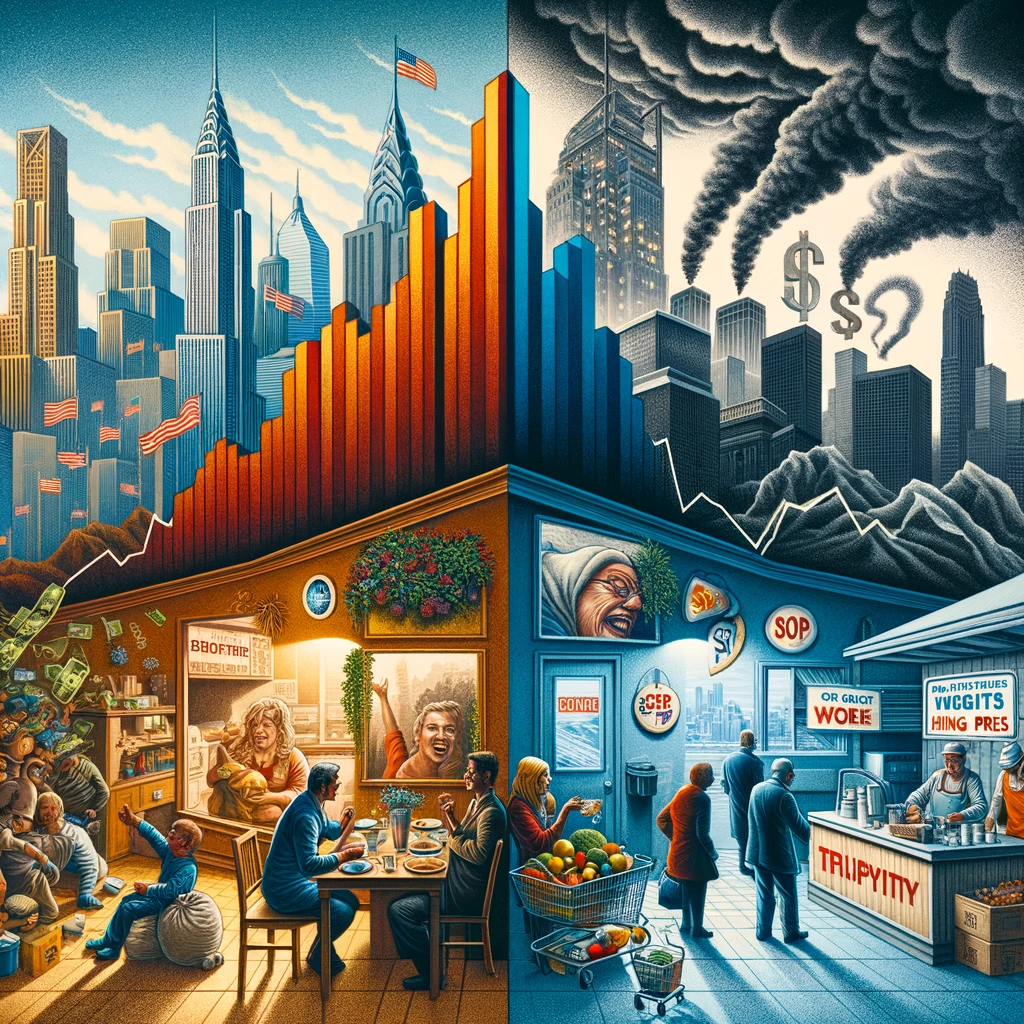
In the grand tapestry of the American economy, there exists a dichotomy so stark it could have been ripped from the pages of a novel. The economy, by certain metrics, appears to be flourishing. Yet, there is a pervasive sentiment that paints a picture of an America in distress, a nation where the cost of living has soared beyond the reach of the common man.
Let me tell you, the price of existence has indeed surged. Rent, new cars, gas, utilities, and food have climbed to heights that would have seemed insurmountable just three years ago. The average family, a unit of four perhaps, grapples with the relentless tide of rising interest rates, the gnawing fear of job loss, and the erosion of their purchasing power as inflation devours their modest grocery budget.
The reality of the situation is not confined to the abstract realm of economic indicators; it is etched in the furrowed brows of those who find themselves on the brink of financial ruin. For many, an unexpected bill of $500 is a catastrophe waiting to happen, a stark reminder of the paycheck-to-paycheck existence that has become the norm rather than the exception.
The narrative that the economy is robust is a half-truth at best. It is a narrative that fails to acknowledge the lived experiences of countless individuals. The numbers may tell a tale of stability, but they do not reflect the silent struggles of those who have seen their salaries stagnate while their cost of living has ballooned.
The dissonance between the statistical portrayal of economic health and the palpable anxiety of the populace cannot be dismissed as mere exaggeration. There is a tangible disconnect between the ivory towers of high society and the reality on the ground. It is a disconnect that breeds disillusionment and fosters a sense of abandonment.
The technocrats may tout the resilience of the economy, but they do so from a position of privilege that blinds them to the everyday hardships faced by the masses. The narrative of prosperity is a bitter pill to swallow for those who find themselves choosing between filling their gas tanks and filling their pantries.
The truth is, the American economy is a complex beast, one that cannot be tamed by optimistic projections or rosy retrospectives. It is an entity that is as susceptible to the whims of global forces as it is to the internal machinations of policy and governance.
As an observer of this unfolding drama, I am compelled to acknowledge the disquieting reality that for many, the American Dream has become an American struggle. It is a struggle that is not captured by the cold calculus of economic models or the detached analysis of pundits.
The economy may be doing "amazingly well" for some, but for others, it is a daily battle to stay afloat. It is a battle that is fought in the grocery aisles, at the gas pumps, and in the quiet desperation of living rooms across the nation. It is a battle that deserves to be recognized, not dismissed with a wave of the hand or a turn of phrase.
In the end, the state of the economy is a tale of two Americas: one that thrives and one that strives. It is a tale that demands our attention, our empathy, and our action. For in the end, the true measure of an economy is not found in the abstract, but in the well-being of its people.